
For veterans and military families considering homeownership, the financial advantages of a VA home loan may be especially valuable in today’s evolving real estate market.
Housing conditions have changed considerably from the intense competition of previous years. In many communities, buyers now have a wider selection of properties, more time to evaluate their options, and greater opportunities to negotiate favorable purchase terms.
For eligible military buyers, these changes can complement the benefits already available through the Department of Veterans Affairs home loan program.
However, misconceptions about VA financing continue to influence how some buyers and sellers approach these transactions. Understanding how the program actually works can help military families make informed decisions and recognize opportunities they might otherwise overlook.
The Benefits of VA Home Loans
The VA home loan program has helped generations of military families pursue homeownership while reducing some of the financial barriers associated with purchasing a property. According to the Department of Veterans Affairs, approximately 4 million veterans and service members currently have active VA home loans. During its most recently reported fiscal year, more than 343,000 homes were purchased using VA loan benefits.
These figures reflect the program’s continued importance in helping eligible borrowers finance their homes.
For eligible veterans and service members, VA loans offer advantages that can make buying a home more affordable, including:
- No down payment required for many eligible borrowers.
- No monthly mortgage insurance, even with no down payment.
- Competitive mortgage rates that can help lower monthly payments.
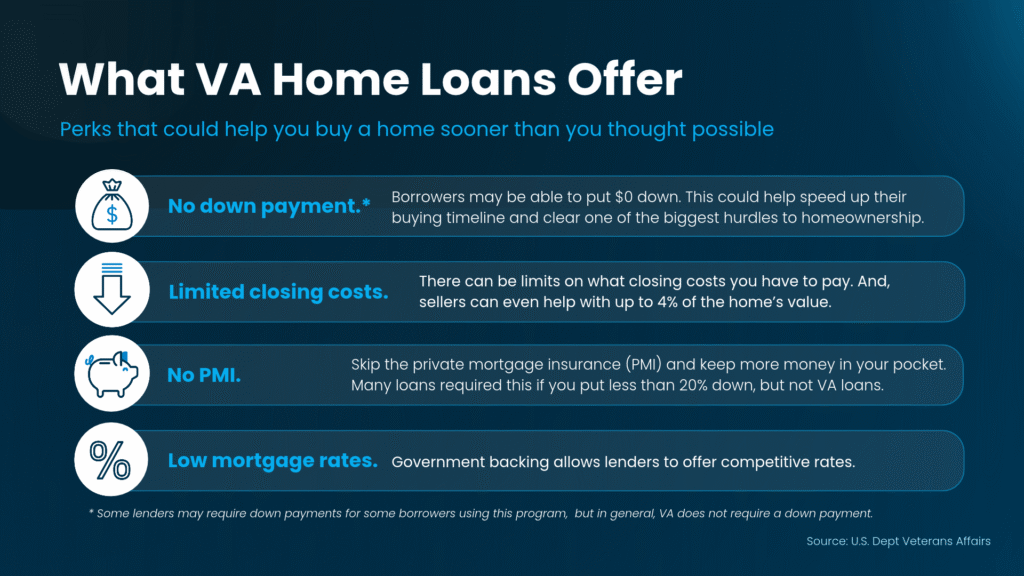
Benefits like this are powerful in any market – and even more so today. That may be why VA loan usage has grown for the last two years in a row.
Why Today’s Market Could Be Different for VA Buyers
A few years ago, when homes were getting multiple offers and buyers were competing for nearly every listing, VA buyers sometimes had a harder time getting their offers accepted.
A 2021 survey from the National Association of Realtors (NAR), found 89% of sellers were likely to accept an offer from a buyer using a conventional loan. But only 30% were likely to accept one using an FHA or VA loan.
The reason? Some sellers were concerned that VA financing would take longer, be more difficult to close, and require them to pay more in costs and repairs. But those concerns don’t necessarily reflect how VA loans actually perform.
Separating VA Loan Misconceptions from the Facts
A white paper from Vetted VA based on 2025 mortgage data busted a lot of VA loan misconceptions:
Misconception 1: VA Mortgage Applications Are More Likely to Be Rejected
Some borrowers assume that VA financing involves a more difficult approval process than conventional mortgages.
The reported figures suggest otherwise.
The study found that VA purchase applications had a denial rate of 8.2%, compared with 15.0% for conventional loans, 12.8% for FHA loans, and 12.5% for USDA loans.
While approval always depends on an applicant’s financial circumstances and lender requirements, these results challenge the belief that VA financing is inherently more difficult to obtain.
Misconception 2: VA Loans Have a Greater Risk of Falling Through
Another concern involves whether a transaction financed through a VA loan is likely to reach closing.
According to the same research, approximately 90% of VA mortgage applications that reached underwriting proceeded to closing.
For conventional mortgages, the comparable figure was 81%.
These findings suggest that VA financing can be a dependable option for buyers and sellers when the borrower meets the necessary qualifications.
Misconception 3: VA Appraisals Create Significant Delays
VA appraisals are sometimes viewed as an obstacle because they involve specific property requirements.
However, the research indicates that VA appraisals generally take approximately 7 to 10 business days, a timeframe comparable to conventional and FHA appraisals.
Actual processing times can vary depending on the property, location, and availability of qualified appraisers.
The important distinction is that a VA appraisal does not automatically mean a transaction will take substantially longer.
Misconception 4: Sellers Must Cover Every Closing Expense
Some sellers mistakenly believe that accepting a VA financed offer means taking responsibility for all of the buyer’s closing costs.
In reality, VA borrowers are permitted to pay many customary closing expenses themselves.
The program also allows buyers and sellers to negotiate eligible costs as part of the purchase agreement.
Understanding these guidelines can help both parties structure an offer that addresses their financial priorities without relying on inaccurate assumptions.
Greater Negotiating Flexibility Can Make a Difference
One of the most important developments for homebuyers is the shift in negotiating conditions.
During highly competitive periods, buyers often felt pressure to offer above asking price, minimize contingencies, or accept less favorable terms simply to secure a property.
In markets where listings are taking longer to sell, the conversation may be different.
Depending on the property’s condition, asking price, and level of buyer interest, sellers may be willing to consider adjustments that make the purchase more attractive.
These could include a reduced purchase price, repairs before closing, or financial assistance with eligible closing expenses.
For VA buyers, this flexibility can be particularly useful because the loan program already reduces certain upfront costs.
VA guidelines permit sellers to pay eligible customary closing costs. In addition, certain seller concessions are generally limited to 4% of the property’s established reasonable value.
It is important to understand that this 4% limit applies to specific concessions, not necessarily every seller paid closing expense.
For a qualified buyer, negotiating these terms could help preserve savings that might otherwise be used during the purchase process.
Why Preserving Cash Matters After Closing
The financial responsibilities of homeownership extend beyond the down payment and mortgage approval.
New homeowners should also prepare for property taxes, homeowners insurance, maintenance, utilities, and unexpected repairs.
Even a property in excellent condition may require additional spending during the first several months of ownership.
This is why maintaining available savings can be an important part of a responsible homebuying strategy.
For eligible veterans, the combination of a potential zero down payment mortgage, no monthly mortgage insurance, and negotiated closing assistance may reduce the amount of cash needed at settlement.
However, buyers should still account for the VA funding fee when applicable, along with other expenses that may not be covered by the seller.
The goal is not simply to purchase a home with the smallest possible upfront payment. It is to establish a financially sustainable path to ownership.
What Veterans Should Consider Before Starting Their Home Search
Although VA loans offer significant advantages, every buyer’s situation is different.
Eligibility, income, credit history, existing financial obligations, and available VA entitlement can all influence the financing options available.
Buyers should also understand how their desired purchase price translates into a comfortable monthly housing payment.
Working with a lender experienced in VA financing can clarify these details early in the process.
At the same time, a knowledgeable local real estate professional can help buyers evaluate property values, identify appropriate negotiating opportunities, and understand how current market conditions affect their home search.
For military families relocating to or purchasing within North Texas, local guidance can be especially valuable when comparing communities, commuting considerations, and long term housing needs.
Bottom Line
Veterans and active duty service members have access to a home financing program designed to recognize their service while supporting their homeownership goals.
As market conditions continue to evolve, the advantages of VA financing may become even more meaningful for qualified buyers.
Understanding the program, addressing common misconceptions, and evaluating local negotiating opportunities can help military families approach the purchase process with greater confidence.
If you are a veteran or active duty service member considering buying a home in North Texas, connect with a knowledgeable real estate professional and a VA experienced lender to explore your options.
Your military home loan benefits may provide more purchasing flexibility than you realize.